Caity Zimmerman, Project Coordinator
May 25, 2026
The Athabasca Watershed Council (AWC) is advancing a new approach to State of the Watershed (SOW) reporting. One that moves beyond static PDF-based summaries toward a more integrated, transparent, and adaptive framework. At the center of this shift is the Freshwater Health Index (FHI), a globally recognized tool developed by Conservation International to evaluate freshwater systems through a combination of ecological, governance, and ecosystem service indicators.
This work is being undertaken in collaboration with the North Saskatchewan Watershed Alliance (NSWA), with the shared goal of testing whether the FHI can be adapted into a practical, repeatable model for watershed reporting across Alberta. They pioneered the first use in North America and adapted the framework to an Alberta context. You can view their 2025 SOW report using the FHI framework here: State of the Watershed: North Saskatchewan Watershed Alliance.
Why the Freshwater Health Index?
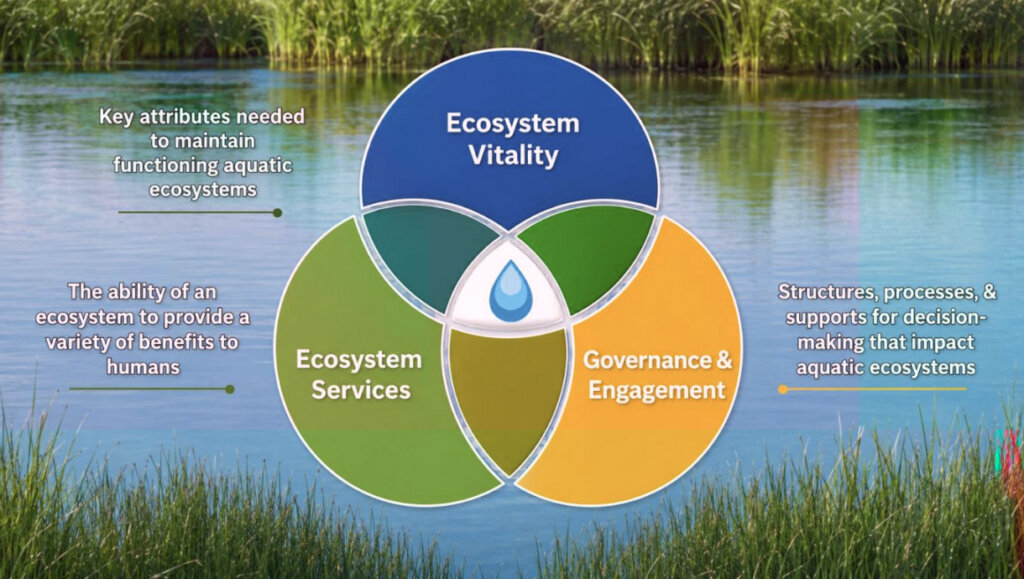
Traditional SOW reports often face a common limitation: they compile large volumes of data but can struggle to clearly connect environmental conditions, human pressures, and governance responses in a way that supports decision-making. The FHI addresses this gap by structuring watershed health into three interconnected components:
- Ecosystem Vitality – the condition and functioning of freshwater systems
- Ecosystem Services – the benefits people derive from water
- Governance & Stakeholder Engagement – how decisions are made and implemented
This structure aligns closely with Alberta’s Water for Life Strategy, which emphasizes healthy aquatic ecosystems, reliable water supplies for people and the economy, and collaborative governance. For AWC, the FHI offers a way to:
- Integrate biophysical indicators (e.g., water quality, flow regimes, land use)
- Incorporate social and governance dimensions often underrepresented in technical reports
- Support adaptive management by linking data to decision-relevant questions
From Static Report to Interactive Platform
A key evolution in this SOW update is how results will be delivered. We are developing an interactive, web-based reporting platform. Rather than relying on a traditional PDF report, ArcGIS Experience Builder will allow easy navigation and user engagement. Our aim is to enhance accessibility and transparency.
What this enables:
- Dynamic Data Visualization
Users will be able to explore indicators through interactive maps, charts, and dashboards. This allows stakeholders to move beyond summary statistics and engage directly with the underlying data. - Incremental Updates
Indicators can be published as they are completed, rather than waiting for the full report to be released. This supports a more iterative and responsive reporting cycle and allows flexibility if changes or new methods and indicators become available. - Multi-Scale Exploration
Results can be viewed at the basin level or broken down into sub-basins, helping local stakeholders better understand conditions in their area. - Clear Communication of Uncertainty and Gaps
“In development” indicators and data gaps can be explicitly displayed, improving transparency and helping guide future monitoring and reporting priorities. This model positions the SOW not as a one-time product, but as a living platform that evolves alongside new data and partnerships.
A Collaborative Test Case for Alberta
AWC’s work with NSWA is not just about producing a single watershed report. It is a deliberate effort to test whether the FHI can function as a standardized yet flexible framework for Watershed Planning and Advisory Councils (WPACs) and similar watershed groups across Alberta. NSWA has also partnered with a sub-regional watershed group, the Vermilion River Watershed Alliance, to evaluate this method at the local stewardship group scale.
Key Aspects of this collaboration include:
Method Development and Alignment
Co-developing indicators and methodologies that can be consistently applied while still allowing for regional adaptation. There is an emphasis on using existing province-wide indicators, such as those developed by the Office of the Chief Scientist and the Alberta Biodiversity Monitoring Institute, reaffirming their importance for future updates.
Cross-Watershed Comparability
Exploring how results can be compared across basins without oversimplifying local context.
Share Tools and Workflows
Building repeatable analysis processes (including automated geospatial workflows) that reduce duplication of effort.
Knowledge Exchange
Regular coordination between organizations to refine approaches, troubleshoot challenges, and document lessons learned.
This collaborative model reflects a broader shift toward networked watershed governance, in which WPACs are not working in isolation but are actively aligning their methods and sharing capacity.
Implications for Watershed Management
If successful, this approach has several implications for how watershed information is generated and used in Alberta:
Improved Decision Support
By linking ecological conditions, human use, and governance, the FHI framework provides a more complete picture for decision-makers.
Greater Transparency and Engagement
Interactive reporting lowers barriers to access and allows stakeholders to engage with the data directly.
Scalability and Efficiency
Standardized methods and automated workflows make it easier to update SOW reports over time.
Stronger Cross-Basin Alignment
A shared framework supports provincial-level conversations about water management while still respecting regional differences.
Looking Ahead
The Athabasca SOW update represents an important transition from retrospective reporting to a more integrated, adaptive, and accessible watershed assessment system.
Over the coming months, AWC will:
- Continue refining indicators within the FHI framework
- Expand stakeholder engagement, particularly around governance and stewardship
components - Release interactive SOW content through Experience Builder
- Document methods and lessons learned to support replication in other watersheds
This work is still evolving, but the direction is clear: toward a reporting model that not only describes watershed conditions but also actively supports informed, collaborative water management across the Athabasca and Alberta.
If you are interested in this work or would like to explore collaboration opportunities, AWC welcomes ongoing dialogue with partners, practitioners, and communities across the basin. Please contact: Caity@athabascawatershed.ca.
Interested in AWC’s previous SOW reports?
State of the Watershed | Athabasca Watershed Council