
By Petra Rowell, Executive Director
As they say, ‘time flies when you’re having fun’! The past five years have certainly flown by, so I must have been having fun! 😊 Looking back, I knew it wasn’t going to be a walk in the park when I accepted a position with the Athabasca Watershed Council (AWC) on February 8, 2021. Like many small non-profit organizations, there is always a lot to do and never enough time or people to get it all done. Still, I was excited to get started and looking forward to getting to know more about the Athabasca River, as well as the people and communities found within its larger watershed.
Large northern rivers have always been a part of my life. I was born in Whitehorse, where the hospital is literally a stone’s throw from the fast-flowing Yukon River. Growing up, we moved around the northwest a fair bit. This included time in Fort Simpson, where the massive Liard and Mackenzie rivers meet, as well as Fort Smith, on the banks of the Slave River and its world-renowned rapids. In northwestern Alberta, we spent time getting to know the Hay River system, visiting Alexandra and Louise Falls, or fishing on the Chinchaga River, a major tributary. With grandparents in northeastern British Columbia, we crossed the mighty Peace River every summer, first at the beautiful Dunvegan (stopping at the market gardens to pick strawberries), again at Taylor Flats before Fort St. John, and lastly, via the Hudson’s Hope Suspension Bridge with the Peace Canyon Dam visible upstream.
So, although it’s a bit farther south, and not as big as its northern cousins, the Athabasca River intrigued me with its own charm and importance as an area draining one quarter of Alberta’s land base. And over the past five years, I’ve enjoyed getting out to see as much of it as I can.
Like millions of others who appreciate our mountain parks, I was very fortunate to drive south on the Jasper-Banff Parkway, just a few days before the fire went through in 2024. While the much-visited Athabasca Glacier at Saskatchewan Crossing is well known, it is just one of about 200 glaciers that contribute to the headwaters of the Athabasca River.
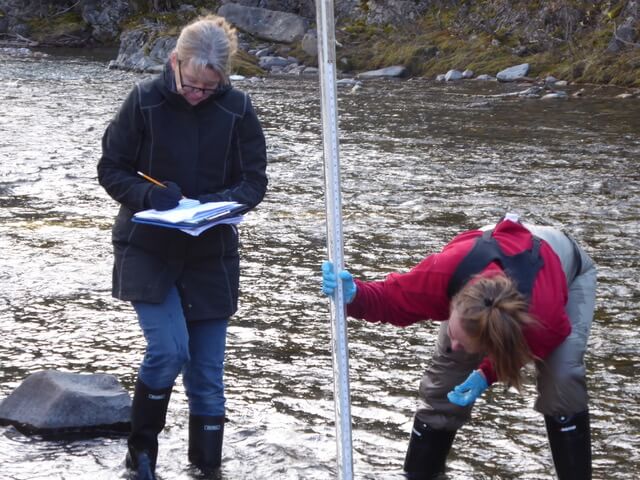

Along with other AWC staff, I’ve also spent time every September for the past five years in the headwaters of the McLeod River (a major tributary of the Athabasca River), visiting several sites along the Hinton-Cadomin-Edson loop where we sample benthic invertebrates. (See our video about this project).
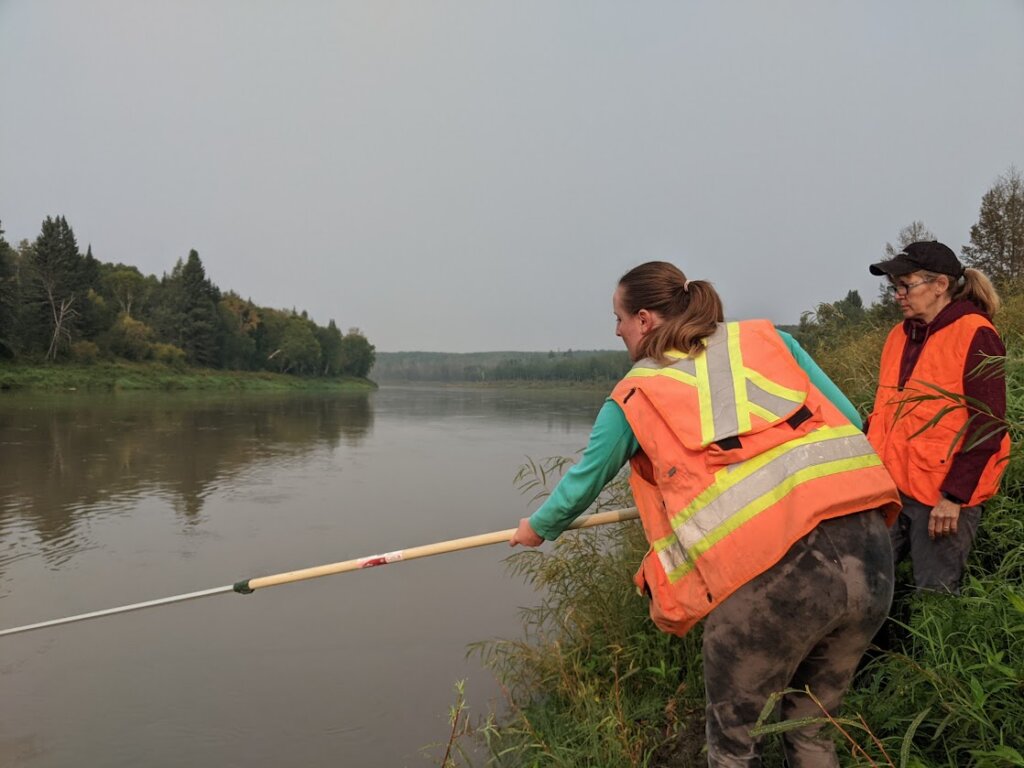
The headwaters of the Pembina River, another important tributary, can be found just a bit farther south of the McLeod, down Highway 40. For the past three years, we’ve travelled the length of the Pembina at least three times between May and September. Each trip, we sample 15 sites in a loop that starts at the river’s mouth just north of Flatbush, working our way southwest down to Entwistle and across Highway 16, then down to Drayton Valley and Lodgepole before following the Elk River Road west to Highway 40 and returning via Edson and Highway 16.
As watershed education is a big part of our mandate, attending events takes us to many locations throughout the basin, where we meet a variety of local people, including students and teachers, mayors and councillors, Indigenous leaders, industry representatives, lake stewardship groups and more. Seeing different parts of the watershed and talking to different people with different perspectives is a great way to learn about an area, as well as any concerns with local water supplies or waterbodies.
Every June, we hold our Annual General Meeting in a different location in the Athabasca watershed. Last summer it was a pleasure to meet in Whitecourt, getting to know the town a bit more, as well as hiking in the gem that is Hard Luck Canyon. Other recent AGMs in Lac La Biche and Fort McMurray have allowed staff and board members opportunities to go birding in Sir Winston Churchill Provincial Park, and to do a driving tour of the oil sands and Fort McKay. The 2023 Fort Assiniboine Bicentennial Voyageur Canoe Brigade was another event that gave several staff and board members the opportunity to spend an entire week on the river, paddling from Whitecourt to the Town of Athabasca, with a two day stop in Fort Assiniboine to help with the celebrations.
As much as I’ve enjoyed my travels to see the different parts of the Athabasca watershed , I’ve equally enjoyed a variety of travelling companions. When I first started, Sarah Shortt (nee MacDonald) was the only other permanent staff person and we got to know one another as we scouted out field sites or traveled to events together. When Ashley Johnson joined us in 2022, our road trip chatter grew as we fed off or each other’s ideas and perspectives. And subsequent staff and board member additions have added to the depth and breadth of conversations and experiences.
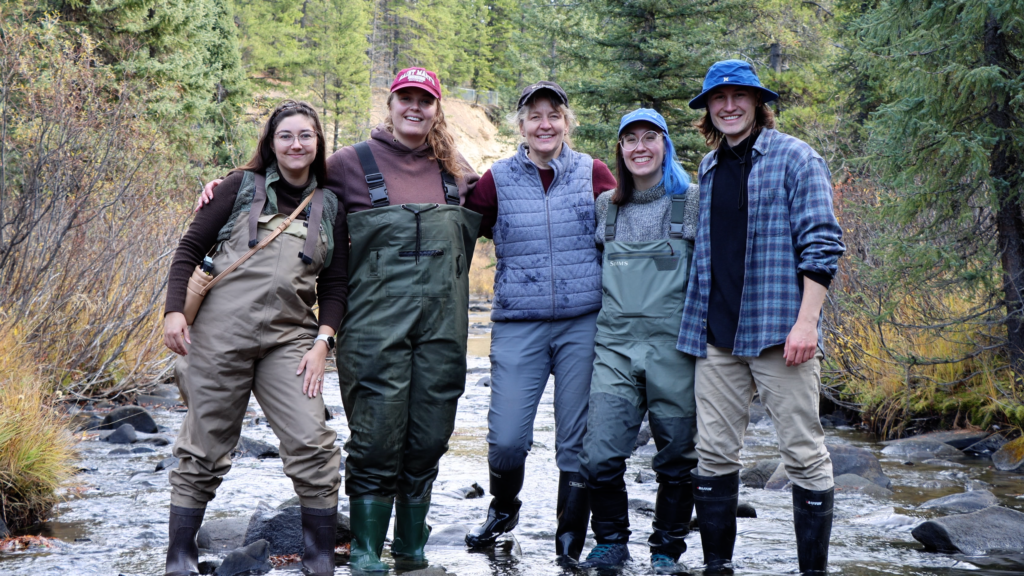
Even though I’ve really enjoyed the past five years of travels and learning about the Athabasca watershed, I still feel like I’ve just barely scratched the surface. I could easily spend the next five years exploring more of its many thousands of miles of streams and numerous lakes, and meeting more of the 200,000 or so people who live and work here.
So I guess if there are any learnings from the past five years to share with AWC Directors and staff, I would encourage everyone to keep being curious about the Athabasca watershed, keeping asking questions, keep finding reasons to go exploring, and keep finding opportunities to meet people where they live. If we follow this advice, I feel that the AWC will continue to not only grow but thrive, and before we know it, the next five years will have gone by.