Healthy watersheds and resilient communities are closely connected. Community resilience is the ability to anticipate, prepare for, respond to, and recover from water-related challenges, like drought, flooding, wildfire impacts, and drinking water risks, while maintaining essential services and well-being.
Community resilience is not just emergency response, it also involves planning, relationships, infrastructure, and good information.
On this page, resilience means:
Our role as a WPAC is to support and connect communities through information, collaboration, and watershed-based perspectives. Emergency response and regulatory services are led by municipalities, Indigenous governments, and provincial authorities. We can help connect communities to the programs and supports that are most relevant to their needs.
Communities across the Athabasca watershed face water-related disruptions that can affect health, safety, and local economies. Building resilience reduces vulnerability and speeds recovery.
Key pressures include:
Community resilience is rooted in the people, cultures, and communities that depend on healthy watersheds. The Athabasca watershed is home to diverse communities that rely on water resources for daily life, economic activities, and cultural connections.
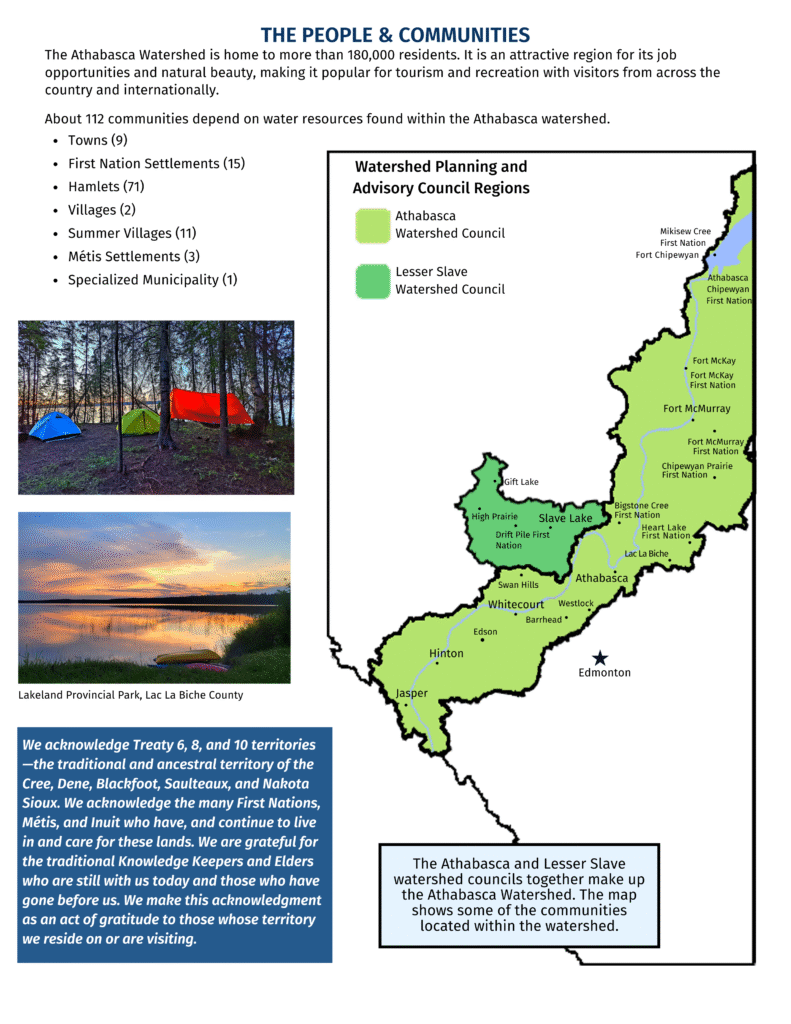
Water problems are rarely isolated to one town or one intake. A watershed approach helps communities manage risk at the right scale—upstream to downstream.
Benefits of a watershed approach include:
Supporting resilient communities aligns with Alberta’s Water for Life strategy, which prioritizes safe, secure drinking water, and healthy aquatic ecosystems.
AWC supports resilience by:
Collective actions that help strengthen water resilience include:
Safe, reliable drinking water is essential to healthy communities, strong local economies, and long-term watershed sustainability. Across the Athabasca watershed, communities rely on both surface water and groundwater sources that can be influenced by climate change, land use, and changing weather patterns.
Drinking water resilience is the ability of a community to anticipate, prepare for, respond to, and recover from disruptions to drinking water supply and quality, while continuing to protect public health and essential services.
Resilient drinking water systems help communities:
In practice, this includes:
Drinking water resilience supports both short-term emergency preparedness and long-term sustainability of drinking water sources.
Protecting drinking water starts long before it reaches a treatment plant. It begins in the rivers, lakes, reservoirs, and aquifers that communities across the Athabasca watershed rely on every day.
Source Water Protection focuses on keeping these water sources clean and healthy. By reducing contamination and taking a watershed-wide approach, communities can lower the likelihood of water emergencies and ensure drinking water remains safe and dependable over time.
collected by community-based water monitors faster, cheaper and more accurately. To learn more about CABIN, check out THIS RESOURCE from fRI.
Source Water Protection means identifying risks to drinking water and addressing them before they reach a treatment facility. Instead of reacting after a problem occurs, this approach looks upstream and across the landscape to understand where risks may arise and how they can be reduced.
Source Water Protection Planning helps communities identify contamination sources, understand how land use and environmental change affect water quality, and put practical actions in place to reduce risk. Over time, this work helps keep drinking water supplies stable.
Protecting water at its source is a key part of the multi-barrier approach to drinking water safety. It works alongside effective treatment, secure distribution systems, and monitoring to keep drinking water safe.
In Alberta, Source Water Protection Planning (SWPP) is supported by guidance developed through the Alberta Water Council. The Council’s framework lays out a clear, step-by-step process communities can use to better protect their drinking water sources.
These resources are designed for municipalities, water utilities, watershed organizations, Indigenous communities, planners, and regulators seeking a consistent and collaborative approach.
The guidance supports communities in:
The Alberta Water Council has also developed the THREATS Tool (Threats to Human Resources from Environmental and Anthropogenic Stressors Tool).
The THREATS Tool allows users to:
Together, the guidance and the THREATS Tool provide communities with a consistent way to assess risks and determine priorities. The Athabasca Watershed Council promotes and applies these tools to support communities across the watershed.
Links:
Alberta Water Council – Source Water Protection Planning Resources
Drinking water sources are shaped by both natural processes and human activities across the watershed. Changes in land use, climate patterns, and water demand can affect both water quality and water availability.
Protecting source water can reduce treatment costs, prevent contamination events, improve preparedness for extreme weather, support ecosystem health, and maintain supply during changing conditions. In many cases, protecting water at its source is one of the most cost-effective ways to safeguard a drinking water system.
Source water protection depends on collaboration. Municipalities, utilities, landowners, Indigenous communities, provincial regulators, and watershed organizations all have a role to play.
Actions may include:
By addressing risks before they reach treatment systems, communities reduce the chance of costly disruptions.
The Athabasca Watershed Council contributes by sharing local data, bringing partners together, and helping communities decide what to do next.
Risks to drinking water reflect a combination of land use, infrastructure, and environmental conditions across the watershed.
Activities across the landscape can influence water quality and quantity, especially when impacts are spread across many areas in the watershed and accumulate over time.
These risks are often spread across many land users and jurisdictions. Managing them takes coordinated land-use decisions, practical on-the-ground actions, and long-term stewardship.
Examples include:
Some risks are linked to industrial facilities and infrastructure. These activities are generally regulated and monitored to reduce risk.
Examples include:
While regulatory systems significantly reduce risk under normal conditions, emergencies can still occur. Knowing how these risks are managed, and how a community would respond if something went wrong, is central to protecting drinking water.
Wildfire Season is from March 1 – October 31 in Alberta.
Learn how climate change is affecting water availability, water quality, extreme weather, and watershed health, and how communities can adapt to changing water conditions.
5101 50 Avenue, PO Box 1058,
Athabasca, AB